scRNA-seq background
Michael Lynch
School of Medicine, University of Limerickmichael.lynch@ul.ie Source:
vignettes/a_background.Rmd
a_background.RmdSingle-cell RNA-seq background
Learning goal
Understand what single-cell RNA-seq data represents, how it is generated, and how that shapes the way we analyse it.
Learning objectives
By the end of this notebook you should be able to:
- Describe what a gene-by-cell count matrix represents, and explain why the counts are relative rather than absolute measurements.
- Outline the main steps of droplet-based data generation: cell capture, cell barcodes, UMIs, sequencing, alignment and counting.
- Identify common technical artefacts (empty droplets, doublets, ambient RNA, stressed or dying cells) and predict how each might show up in the data.
- Sketch an analysis and validation plan for a new dataset before writing any code.
Background
- Single-cell data, as the name suggests, is RNA (gene expression) measured at the level of single cells.
- The data is tabular, where rows are genes, columns are cells, and values represent a count of how many of each RNA was measured in each cell when the experiment was carried out.
- This count is not an absolute measurement, and is impacted by both experimental and biological factors.
- Cells are dynamic, so think of it as a snapshot of the cell’s state at a moment in time.
- Cells differentiate and specialise, meaning they have a hierarchical structure.
Data generation
- Single cells are isolated from a tissue or blood sample, often using a microfluidics platform such as the 10x Genomics Chromium system.
- Each cell is captured in an oil droplet with a unique barcoded bead, allowing molecules from that cell to be tracked throughout the experiment.
- Cellular RNA is converted to cDNA and sequenced, generating millions of short sequencing reads made up of base pairs A, T, G, and C.
- The reads are compared to a reference to determine which gene they represent.
- Unique molecular identifiers (UMIs) ensure each molecule is counted only once.
- Barcodes assign the UMIs back to cells.
- A gene-by-cell count matrix is created, providing the starting point for downstream analyses such as quality control, clustering, and cell-type annotation.
Technical artefacts
- RNA-seq is harsh on cells, some cell types handle this better than others.
- Some droplets contain no cells.
- Some droplets contain multiple cells.
- Ambient RNA from dead cells also gets captured.
We won’t get into detail on all of these, but they are important to be aware of.
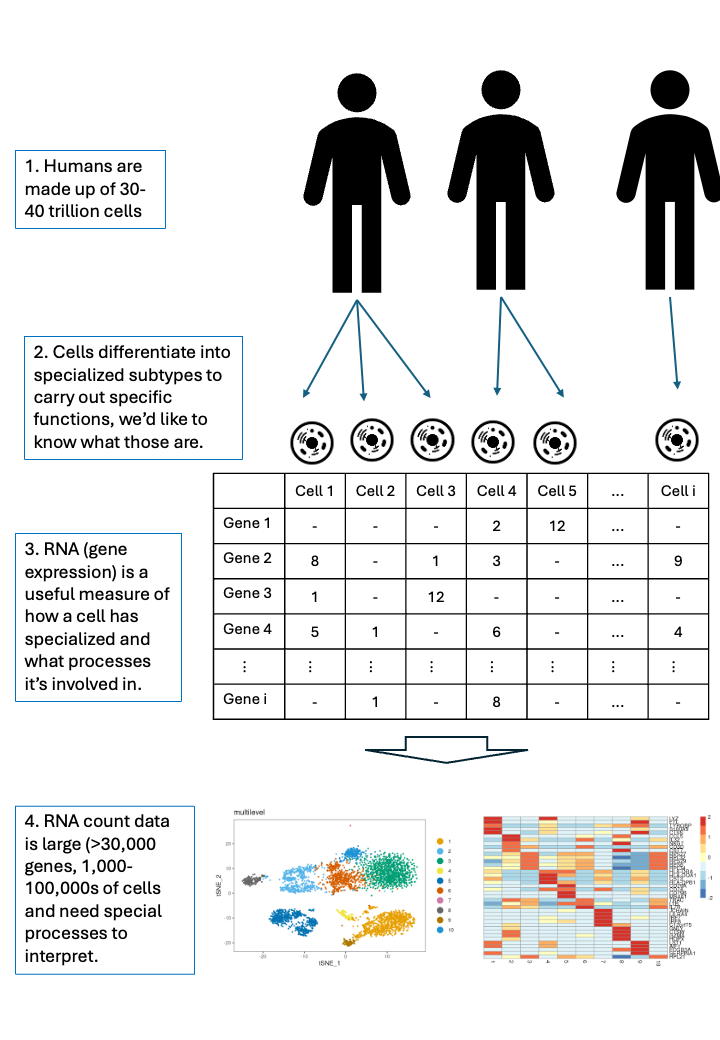
RNA extracted from single cells can be measured and analysed.